Project Description


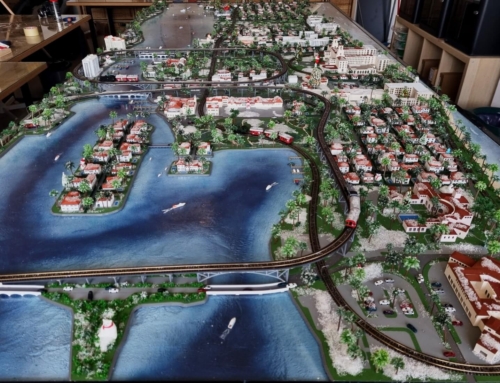
This professional urban planning model presents an extensive and complex section of the city of Omaha, Nebraska, with particular attention paid to the topography and infrastructure. The entire piece is rendered in a monochromatic palette of white and blue, which emphasizes structure and spatial relationships rather than superficial details.
The dominant natural element is the Missouri River, represented by a wide strip of glossy blue material that cuts across the model. It serves as a natural boundary and a convergence point for urban development.
The transportation infrastructure is exceptionally detailed. A vast network of highways, access ramps, and rail lines traverses the nearest bank and spans the river via a complex bridge. These smooth, elevated white lines dominate the foreground, illustrating the crucial importance of logistical and road connections in this metropolitan area.
The urban planing clearly differs between the two banks:
- On the far bank, there is a high construction density, symbolized by numerous tall and tightly packed rectangular blocks, typical of a downtown (Central Business District) or a major metropolitan area.
- On the near bank, the built environment is lower, more spread out, and more irregular, suggesting residential neighborhoods, light industrial areas, or suburban development zones.
The use of uniform white for the relief and buildings allows the focus to remain on volume, scale, and the way human engineering has been integrated into the natural landscape.
Massing models are an essential stage in the design process. Thanks to them, an architect will be able to organize the project so that it corresponds both to customers’ requirements and needs, as well as to the environment.
For many large-scale projects, such as urban planning ones, the architects will focus in the first stage on the overall details, which are necessary to closely analyze and study the shape, design, proportions, but also the way they integrate in the space.
Massing models are beneficial for both architects and investors because they allow a more detailed visualization of the shape and design, potential mistakes can be noticed in advance, and this is also a more convenient way to find design alternatives.