
3D printing has opened new horizons in the creation of architectural models. What seemed to be SF a few years ago has now become a reality and a great opportunity to create 3D models. 3D printing technology does not stop here, but is constantly expanding, as more and more industries identify new solutions in which they can integrate 3D models.
3D printing brings several advantages in the creation of architectural models.
But, first, let’s see what 3D printing is.
About 3D printing
This technology involves several processes to create different models from a wide range of materials. In other words, with the help of ultra-modern machines (3D printers), numerous three-dimensional models can be obtained. During printing, several layers of material are overlapped in order to give a final shape to the printed object.
3D printing improves production and facilitates several meticulous operations when architectural models are created. Compared to other production processes, 3D printing allows adding extremely small, millimeter-scale layers, which is a huge plus in making models of different sizes.
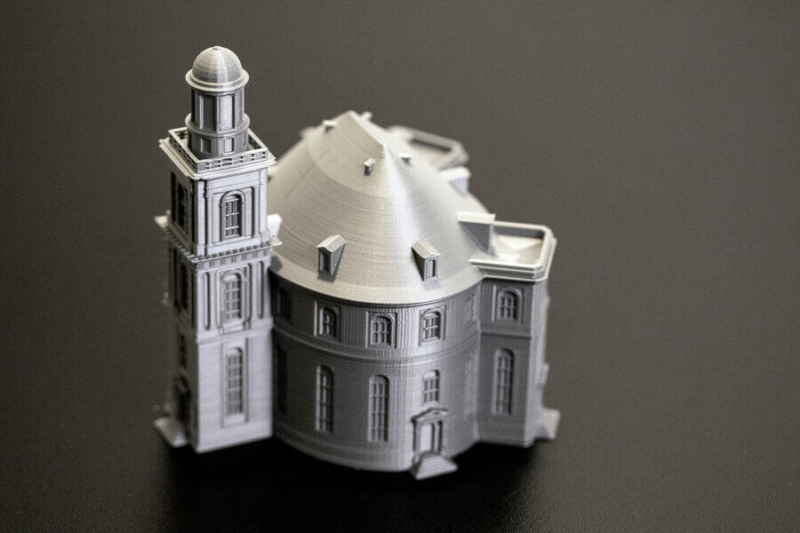
3D printing in the creation of architectural models
When we talk about architectural models, 3D printing begins with a three-dimensional digital model. This is basically the basis of the product, and architects use several complex programs such as 3D CAD.
After preparing the design of the model to be made, the model is divided into several layers, which helps to facilitate the reading operation by the 3D printer.
After dividing the model into layers, the actual printing takes place, using the chosen material. The physical 3D model will be made layer by layer according to the initial digital model.
With the help of a 3D printer it is much easier to print complex models, made of various materials and in a shorter time. Also, the end result will be much more accurate.
How does 3D printing help create architectural models?
There are several benefits that 3D printing brings in the creation of architectural models.
- Shorter execution time
- Since the human factor in making architectural models is removed, the execution time will be shorter. Thus, we will be able to hand over a project for an architectural model of a house, a residential neighborhood in a faster way, etc.
- Various parts and larger models can be printed
3D printers can be used to print parts that will be quickly added to the architectural model. For example, you can print lighting poles that will then be placed on the model.
Likewise, you can print recycle bins, cars, people and other elements that will make the model more human. But in addition to parts for architectural models, larger models can be printed on 3D printers. For example, you can print 3D models of compact or loose blocks, which will then only be assembled, like a 3D puzzle.

Higher accuracy
Another advantage of 3D printing in creating architectural models is its accuracy. Before printing the required models, the initial digital models will be analyzed. Several complex programs can be used for analysis, and human error is greatly minimized, because the calculations are done by the computer.
Thus, before the actual printing, the operator can more easily check the accuracy of the model to be printed. Apart from precision, we must say that the architectural models made with the help of 3D printers are better finished. The pieces are perfectly made, and the architectural models look much more attractive.
Simplicity
3D printing with 3D printers is simpler than we thought. These ultra-modern machines operate with all kinds of architectural concepts, form and content, so the whole process is much simplified.
We also successfully use 3D printers to make architectural models. They help us obtain exceptional, professional models, very well finished, of a high quality, various lasting materials which are delivered in a short time.
If you need a model for an important project, feel free to call us for a customized offer.


