
In the world of hyperscale facility design, there’s no margin for error. A $2M+ data center project demands absolute precision—where a spatial miscalculation of just a few centimeters can cascade into millions of dollars in cooling inefficiencies, power distribution failures, or compromised redundancy systems. When uptime guarantees of 99.99% are contractually mandated, every decision must be validated before the first concrete pour.
This is where data center architectural models transcend traditional presentation tools. They become engineering validation instruments that save projects from costly mistakes.
Why physical Scale Models are essential for Data Center Development
The complexity gap: Why digital isn’t always enough
Development teams already work with sophisticated BIM software and 3D renders. So why invest in a physical scale model? The answer lies in how the human brain processes spatial complexity.
Digital models excel at data. Physical models excel at comprehension. When evaluating hot aisle/cold aisle configurations, cable tray routing above a 400,000 sq ft raised floor, or the spatial relationship between backup generators and fuel systems, the tactile three-dimensional object provides immediate clarity that screen-based walkthroughs cannot match.

Physical infrastructure visualization allows engineers and stakeholders to observe sightlines, identify maintenance access bottlenecks, and understand equipment density in ways that feel intuitive rather than abstract. Decision-makers can physically point to problem areas, rotate perspectives without software lag, and grasp the true scale of technical challenges instantly.
Strategic benefits for Data Center Development
-
MEP visualization that eliminates guesswork
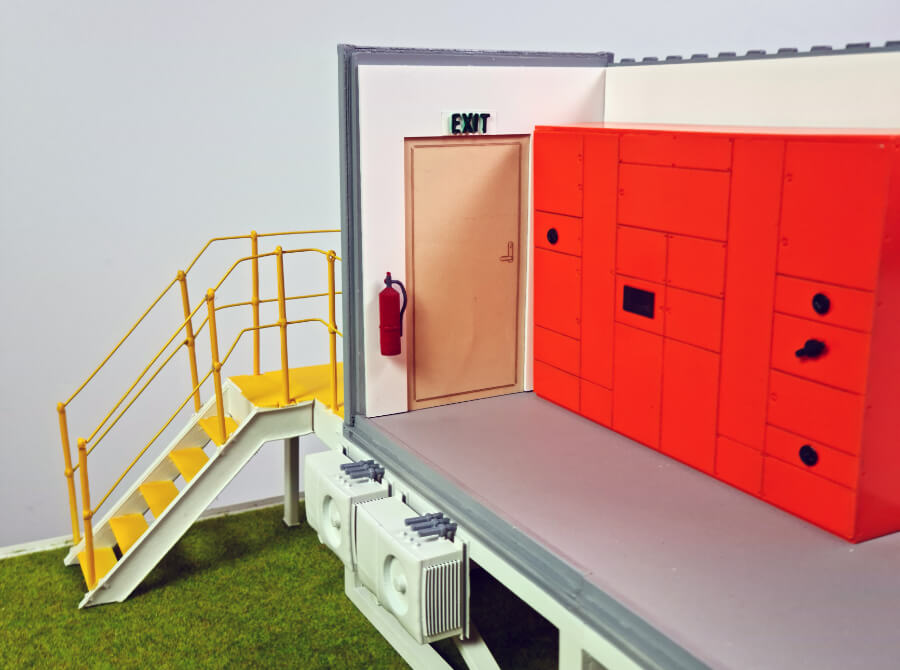
MEP scale models provide unparalleled clarity for mission-critical systems. Complex chilled water loops, DX cooling units, busway power distribution, and redundant UPS pathways become tangible and traceable. Engineers can verify that N+1 or 2N redundancy configurations are geometrically feasible before installation begins.
Hot spots, clearance conflicts, and maintenance access issues that hide in 2D drawings or even 3D renders become immediately obvious when examining a precision-cut physical model.
Engineers can verify that N+1 or 2N redundancy configurations are geometrically feasible before installation begins. Hot spots, clearance conflicts, and maintenance access issues that hide in 2D drawings or even 3D renders become immediately obvious when examining a precision-cut physical model.
Stakeholder alignment and accelerated decision-making
In board meetings where institutional investors, facility managers, and design teams converge, a mission-critical facility planning model serves as the central source of truth. Instead of cycling through multiple PowerPoint slides or attempting to interpret construction documents, all parties reference the same physical object.
This eliminates misinterpretation, reduces decision latency, and builds confidence among non-technical stakeholders. When everyone can see and touch the proposed infrastructure, approvals move faster and with greater conviction.
Physical security layer visualization
Data centers operate under extreme security protocols. A scale model clearly depicts multiple security perimeters: exterior fencing, vehicle barriers, man-trap entries, biometric checkpoint locations, and CCTV coverage zones.
Security consultants can evaluate coverage gaps and refine access control strategies before construction. For colocation facilities, the model shows customer cage layouts and demonstrates how secure corridors prevent unauthorized access between tenant spaces.
Phased expansion visualization
Many hyperscale projects roll out in phases—Phase 1 might be 10MW with a master plan for 50MW ultimate capacity. Modular architectural models with removable sections demonstrate both current and future states. Investors see their capital deployment timeline.
Operations teams understand how Phase 2 will integrate without disrupting Phase 1 uptime. This approach proves particularly valuable when negotiating power utility agreements or planning substation expansions that must anticipate future load.
The craft: Engineering precision meets architectural clarity
Creating data center architectural models demands technical precision that mirrors the real facility’s tolerances. Professional model-making studios employ CNC machining for structural components, ensuring walls, floors, and equipment platforms maintain exact scale relationships down to sub-millimeter accuracy.
Clear acrylic fabrication allows for “see-through” raised floor sections, making underfloor cooling plenums, cable management, and structural support systems visible without disassembly. This transparency proves critical when validating airflow dynamics or tracing emergency power paths.
Dynamic LED lighting systems embedded in the model can demonstrate power redundancy schemes—illuminating which UPS units serve which server rows, or showing backup generator switchover sequences. Color-coded lighting can also visualize thermal zones, helping MEP engineers optimize CRAC unit placement.
Sustainability and operational efficiency
As the industry faces increasing pressure to reduce PUE (Power usage effectiveness) and carbon footprints, physical models help visualize green initiatives that impact both design and stakeholder perception.
Solar array placement on data hall roofs, rainwater harvesting systems for cooling tower makeup water, and heat recovery systems for adjacent buildings all become concrete and compelling when shown in a scale model. ESG-focused investors can see sustainability commitments translated into physical infrastructure rather than abstract promises.
The model also helps facility managers plan for future efficiency upgrades—identifying roof load capacity for additional solar panels or space for next-generation liquid cooling systems as IT equipment densities increase.
The insurance policy against design misunderstanding
In an industry where downtime is measured in thousands of dollars per minute and construction errors can derail go-live schedules, a precision physical scale model is not a luxury—it’s risk mitigation. It transforms complex technical specifications into something every stakeholder can understand, evaluate, and confidently approve.
Before committing hundreds of millions to breaking ground, development teams must ensure that every spatial relationship, every redundancy pathway, and every maintenance consideration has been validated in three dimensions. A professionally crafted architectural model serves as an insurance policy against the most expensive mistake in construction: discovering a critical design flaw after the walls are up.
Case study: Campus Master Plan Model
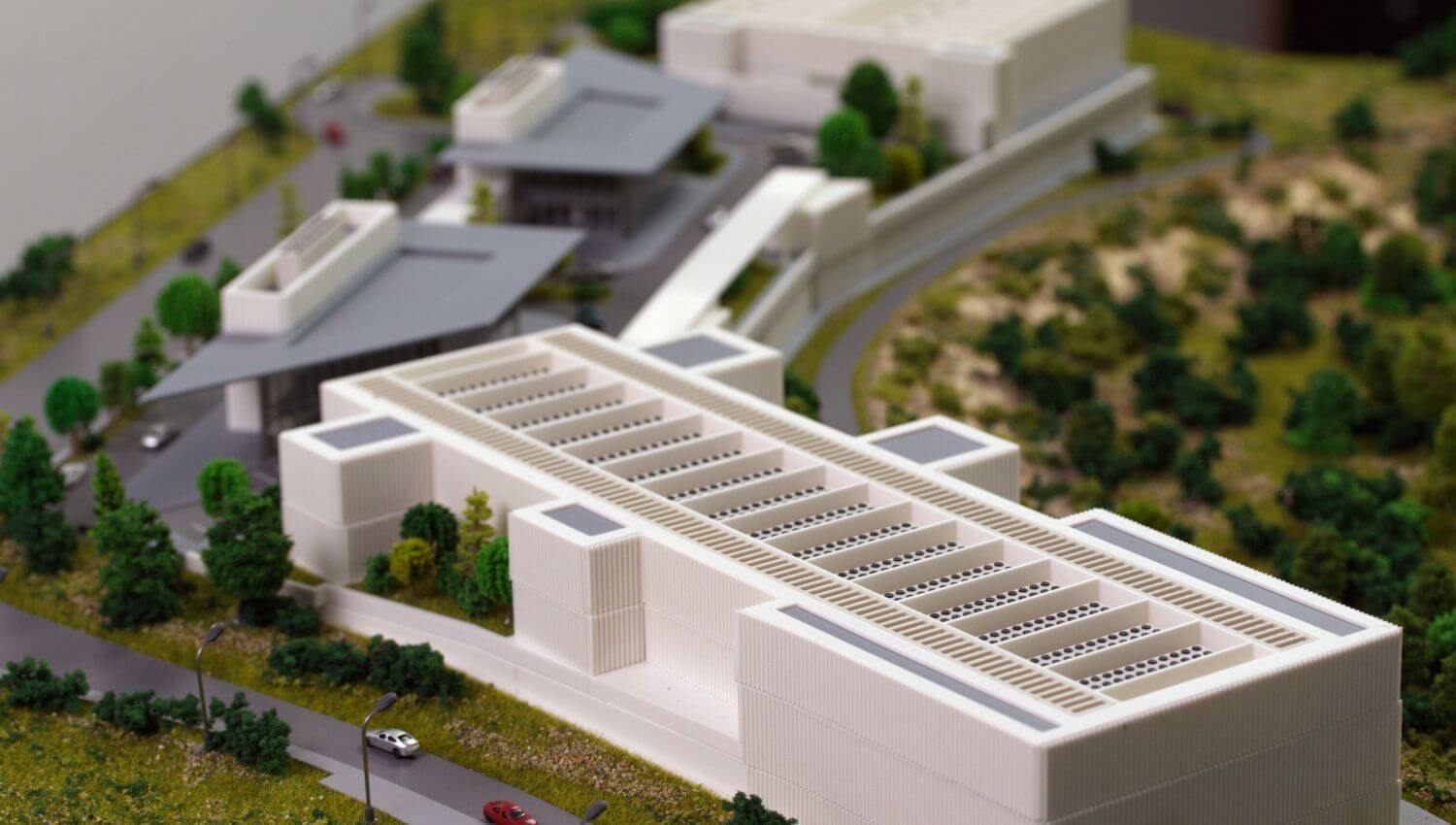
Recently, our studio completed a comprehensive master plan model for a phased data center campus development. The 1:200 scale model featured modular buildings with removable roof sections, allowing the development team to showcase both the completed Phase 1 facility and future expansion zones.
Key features included: precision-cut white acrylic data halls revealing internal server row layouts, landscaped perimeter security zones with miniature trees and fencing, rooftop HVAC equipment and solar arrays, and color-coded pathways distinguishing between utility infrastructure and secure access routes.
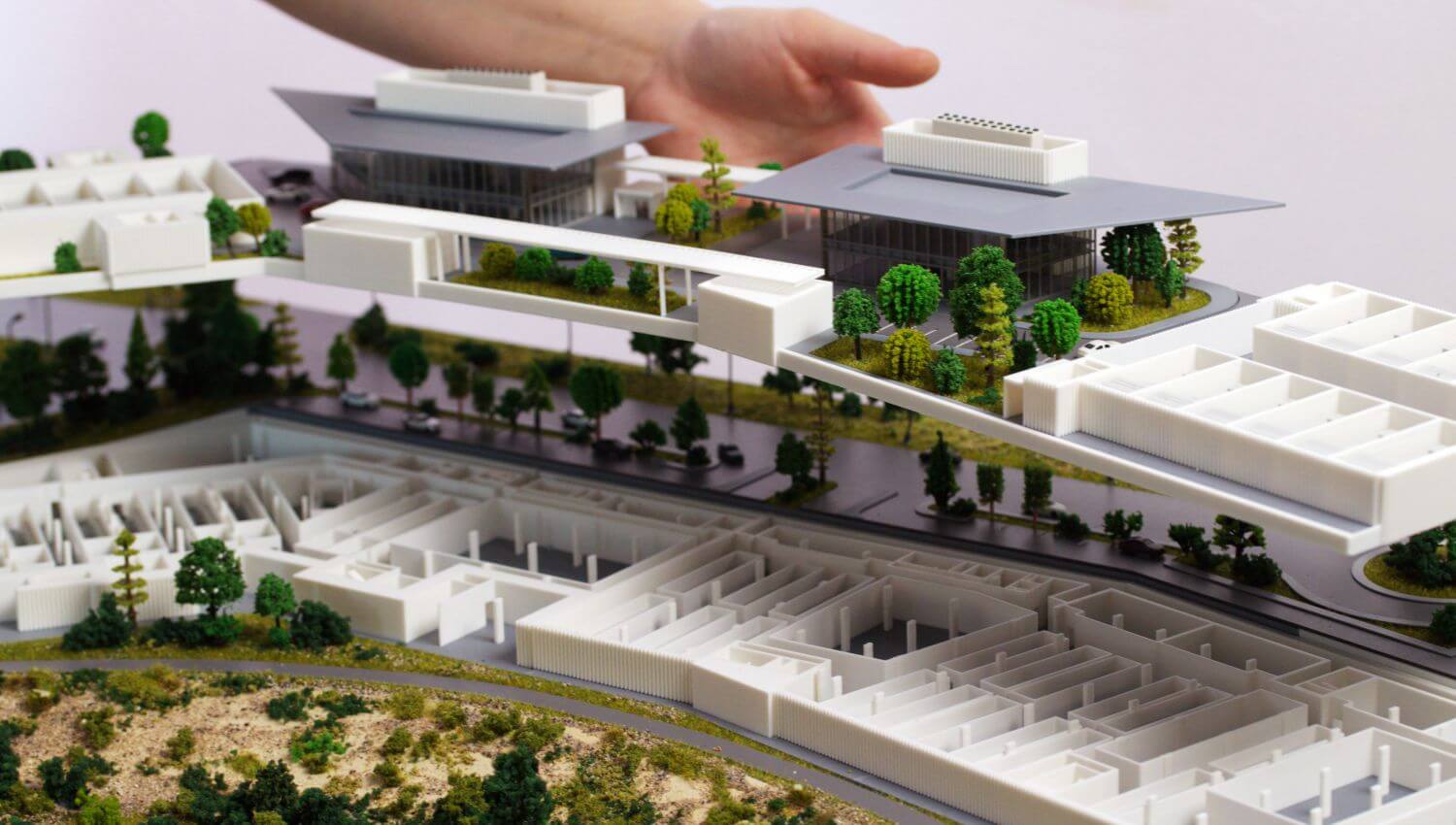
The model became the centerpiece of investor presentations, reducing the approval timeline by six weeks. Stakeholders could physically lift roof sections to examine cooling systems and understand the logic behind the phased power distribution strategy—something that proved impossible to convey through digital renderings alone.
Ready to bring your project into the Physical Dimension?
Whether developing a hyperscale cloud campus, an enterprise colocation facility, or a telecommunications carrier hotel, professional architectural model-making transforms complex data center designs into tangible validation tools.
Contact our studio for a technical consultation and discover how a precision physical model can accelerate approvals, eliminate costly errors, and give your stakeholders the confidence they need to move forward.
Expert architectural model-making for the infrastructure that powers the digital world.
Blueprint Models is an international architectural model-making studio founded in 2006. With a team of professional architects, we specialize in high-precision industrial models, including hyperscale data centers and mission-critical infrastructure, serving clients across the USA, the Middle East, and Europe.
Frequently Asked Questions
How long does it take to produce a data center architectural model?
Production timelines typically range from 4-8 weeks depending on complexity, scale, and level of detail required. Rush services are available for time-sensitive presentations.
What scale is recommended for data center models?
Most mission-critical facilities work best at 1:100 or 1:200 scale, balancing detail visibility with overall campus context. Smaller presentation models at 1:500 scale are also common for master planning.
Can models show interior technical systems?
Yes. Removable sections, transparent acrylic floors, and cutaway views reveal raised floor plenums, cable management systems, cooling distribution, and power redundancy pathways.
Are these models durable for travel and multiple presentations?
Professional models are built with reinforced bases, protective cases, and modular construction that allows for safe transport to roadshow presentations and trade shows.